
Whitepaper
Leveraging Artificial Intelligence for Sales and Revenue Operations
Sponsored by

Over the past decade, the way commercial organizations plan, execute and grow has been reshaped by data, technology and increasing expectations of what sales and revenue operations (“RevOps”) teams are required to deliver. In this new landscape, artificial intelligence (“AI”) has become a pillar of modern commercial strategy. The organizations that have moved from experimentation to execution are already pulling ahead.
For many companies, the first phase of that journey is behind them. AI has been piloted and experimented with. Yet in most cases, these initiatives are quietly shelved when results fail to materialize at speed or scale. In contrast, leading organizations have moved decisively from experimentation to execution. These top performers focus on fewer, high-ROI use cases, embed AI into revenue-critical workflows and have built the operational infrastructure to scale and sustain results.
Crucially, the differentiator is not the technology itself or even the specific AI tools deployed. What determines success is the discipline to treat AI as a commercial transformation and the enterprise architecture to connect it within existing workflows. That means building the RevOps infrastructure to govern it, investing in a connected platform that enables it to scale and creating the organizational alignment that drives real adoption.
The impact is especially significant in sales compensation and talent management. Sales compensation is the most powerful lever available to commercial leaders and one of the most operationally burdened. In this domain, AI has already been proven to reduce administrative load, improve quota accuracy, personalize plan communication and strengthen talent retention.
While every business has unique objectives and challenges, the organizations successfully scaling AI share a common set of structural principles and best practices that apply across a wide range of commercial models.
From Experimentation to Execution
Across nearly every commercial organization, AI is everywhere: in pitch decks, board presentations and technology roadmaps. But for the majority of those organizations, it’s not in daily workflows and it’s also not generating measurable outcomes. Over 80% of companies have piloted AI tools, yet fewer than 5% have moved their AI solutions into production.1 This gap represents a significant opportunity for organizations to stand out through effective AI scaling.
The Strategic Shift
Between 2024 and 2025, organizations shifted from broad experimentation to more focused AI pilots. 63% of firms were running five or more AI use cases concurrently in 2024, reflecting broad experimentation and a strong appetite to explore AI’s potential. By 2025 this pattern had shifted, with 64% of firms running fewer use cases at once and concentrating investment on pilot initiatives with clear, measurable ROI.2
In 2026, successes from targeted individual use cases are no longer enough to appease investor and customer expectations. Top organizations are hurdling towards successful broad AI implementation and outpacing their peers. As such, AI GTM strategy is shifting from focused use case experimentation to driving AI use cases that generate strong ROI across the entire enterprise, otherwise known as “institutional implementation”. However, failures in scaling from individual use case experimentation to institutional implementation are common.
Why Scaling Has Failed
For most organizations, the barrier to scaling AI has been four structural failures. Overcoming these barriers is essential to capturing the differentiation opportunity outlined above.
Fragmented Data
First, AI is only as effective as the context and data it can access. When the underlying data that AI is pulling from is unreliable, even the most sophisticated model will produce inadequate outputs. The average commercial technology stack is comprised of 10 to 15 platforms.3 These systems usually operate with inconsistent data definitions and limited connectivity to one another, generating their own signals with no shared view of commercial performance. Survey data reflects this, with 52% of respondents citing data quality and availability as the primary challenge as well as fragmented data becoming unmanageable at scale.4
Unclear Ownership
In many organizations, the most fundamental question remains unanswered: Who owns AI? Is it the technology team that deployed it, the commercial teams that use it or a centralized AI function? The reality is that often no one owns it. Use cases are deployed by vendors, experimented with by individual teams and quietly abandoned when results are inconsistent. The data reflects this, with 58% of enterprises reporting no clear ownership of AI initiatives and 75% lacking any formal AI governance structure.5 Without clear ownership, AI initiatives fail to sustain the focus and accountability required to scale.
Weak Change Management
The effectiveness of an AI solution is largely determined by the strength of supporting change management practices. In many cases, tools are implemented without being fully embedded into existing workflows. Sellers are then handed new capabilities without understanding how they connect to their daily priorities and goals. Research finds that 40% of organizations will need to re-skill to reflect AI capabilities,6 and 85% of employees say they cannot apply the AI training they have received to their day-to-day jobs.7 Because of this disconnect, adoption stalls and the value of AI initiatives are undermined.
Organizations that have transitioned from experimentation into execution are already seeing the difference. AI-advanced organizations report a 14% increase in revenue per employee compared to those still in early adoption stages.8 Research confirms that the greatest financial impact arrives when AI moves from isolated pilots into scaled, embedded ways of working.9 For sales and RevOps, this transition starts with a clear view of where the productivity gap actually lives.
Undocumented Workflows and Playbooks
Even with clean data, clear ownership and structured change management, AI cannot function without a codified view of how the business actually operates. In most organizations, critical commercial workflows (such as lead qualification, territory assignment, quota exceptions and compensation disputes) live in institutional memory rather than documented, repeatable processes. Only 16% of organizations report their workflows are extremely well documented, and just 4% say they are not dependent on individual knowledge.10 In this environment, AI either scales inconsistency or fails to embed altogether because there is no defined process architecture to integrate into. The consequence is predictable: 61% of organizations report their AI strategy is only partially aligned or not aligned at all with operational capabilities.11
The Productivity Gap
The Time Problem
When it comes to the biggest inefficiency most sales organizations face, it’s not a poor product, weak pipeline or an under-trained team. Rather, it’s the time sellers waste on non-selling work. Sales reps spend less than one-third of their time actively selling, with the remaining two-thirds consumed largely by administrative tasks, including data entry and internal meetings.12 AI directly addresses this problem by automating the administrative layer: reclaiming an estimated two hours per seller per day13 as well as redirecting that capacity toward the conversations, relationships and decisions that actually drive revenue.14
The Planning Problem
Even when sellers are focused on selling, too many are working against targets that were never grounded in market reality. Only 50% of core sellers achieved or exceeded quota in 2025, leaving half of every sales organization below target.15 At the same time, most organizations deliberately over-assign quotas by 20 to 30% to ensure cumulative attainment aligns with the company’s revenue plan.14 The result is a persistent calibration problem: targets set without sufficient grounding in market opportunity, territories designed on convention rather than data and sellers measured against numbers that do not reflect the reality of their accounts.
Another significant barrier to sales performance is misaligned territory design. In many organizations, account allocation still follows historical convention, with tenured sellers holding the highest-potential accounts while newer sellers inherit weaker territories with lower ICP fit. As a result, performance distribution shaped as much by territory quality as by seller capability. This makes it difficult to assess true productivity, develop talent or scale efficiently. Alexander Group research shows that organizations that optimize territories can realize 10 to 20% increases in sales productivity without adding headcount. Without ICP-informed territory design, sellers inherit accounts with limited conversion potential. Research suggests at least half of prospects in a typical pipeline do not match the ideal customer profile, compounding productivity loss before any selling begins.
Closing the Gap
The companies closing this gap are those decisively adopting AI across sales and RevOps. What was an emerging capability less than a year ago is quickly becoming a competitive baseline.
The performance differential is already measurable. Sales teams regularly using AI generate 77% more revenue per representative than those that do not, representing a six-figure gap per salesperson annually.15 At the seller level, those who effectively partner with AI tools are 3.7x more likely to meet quota than those who do not.16 Effectively, AI eliminates administrative drag, sharpens account prioritization, improves quota accuracy and strengthens retention by giving sellers the tools and visibility they need to succeed.
The Connected Revenue Stack and AI
The value of AI in sales lives in the connection between tools, not in the tools themselves. To deliver meaningful results, organizations must drive adoption across their commercial teams by connecting their revenue stack and integrating their AI solutions into their existing workflows.
50% of sellers feel overwhelmed by the number of applications required to do their jobs, and overwhelmed sellers are 45% less likely to attain quota.17 This disjointed process generates fragmented and inconsistent signals across the revenue stack, leading to weaker planning accuracy, unreliable forecasting and misaligned incentives across the organization.
Alexander Group research reinforces this point. Organizations with highly effective RevOps functions are nearly two times more likely than peers to have sophisticated data-sharing systems, which is the single most important condition for AI to perform at scale.18 A CRM that doesn‘t communicate with a compensation platform, or a forecasting model operating on stale territory data, cannot generate reliable outputs. AI’s effectiveness is determined by the quality and completeness of the commercial context it’s given.
50% of sellers feel overwhelmed by the number of applications required to do their jobs, and overwhelmed sellers are 45% less likely to attain quota.
Connected Data Foundation
The CRM system is the primary data source for AI to generate actionable commercial insights. Win and loss rates, pipeline velocity, activity patterns, customer engagement history and product mix provide the signals used to calculate propensity, estimate opportunity, predict churn and recommend next best actions. The quality of AI outputs is directly proportional to the completeness and accuracy of this data.
CRM is foundational, but it rarely operates alone. Order data, such as purchase history, contract values and renewal patterns, often resides in ERP systems and must be connected to provide a full transactional view. Customer success platforms add another dimension, with product adoption rates, health scores and support interactions often serving as early indicators of churn risk or expansion opportunity.
More than half of organizations allocated AI budget in 2024 to sales forecasting, quota analytics, data cleansing and territory design, all of which depend on these connected data sources functioning as a unified layer rather than in silos.19 As Alexander Group Principal and Data Analytics Leader, Isaac Hausman notes: “AI models are only as good as the data behind them. If the underlying data is not clean, consistent and well understood, AI will simply scale those errors faster and more convincingly.”
SPM as the Action Engine
If CRM is where AI signals are generated, then sales performance management (“SPM”) platforms are where those signals are converted into commercial action. Modern SPM platforms deploy AI across five key use cases that cover the full commercial planning and execution cycle: territory design, quota planning and allocation, plan modeling and simulation, sales forecasting and go-to-market (GTM) capacity planning.
Historically, territory design has been driven by convention rather than data. But AI changes this by combining scenario modeling, mapping and performance data to better balance opportunity, model rep capacity, eliminate overlap and ground targets in market potential.
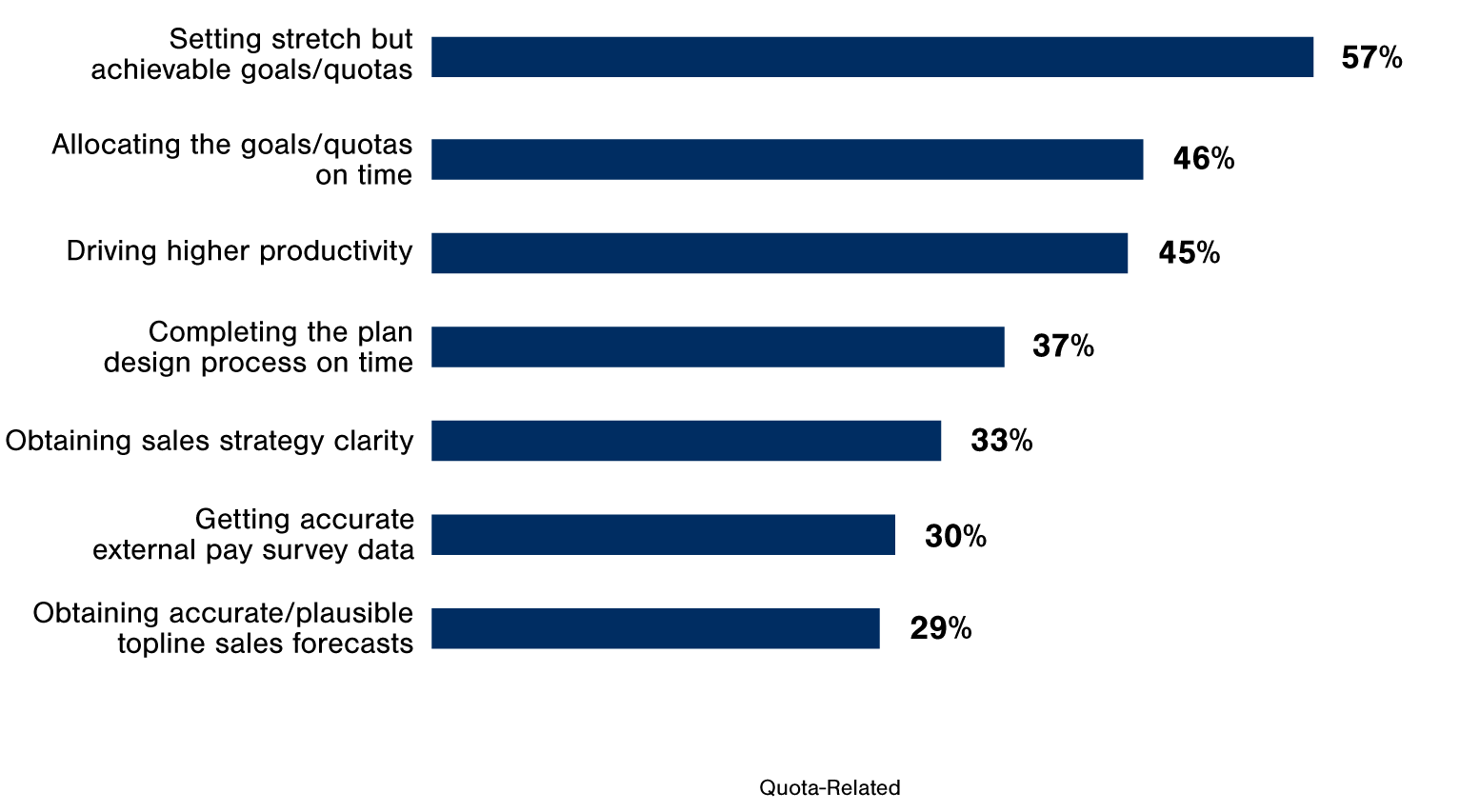
This directly addresses what Alexander Group’s research identified as the number one program management challenge, quota overallocation (cited by 46% of companies), and the number one plan design challenge, setting accurate, achievable quotas (cited by 57% of companies).20 Replacing top-down allocation with AI-driven, market-grounded modeling is the most direct intervention available to leaders that are facing both problems simultaneously.
Plan modeling and simulation extend this solution further. AI can simulate thousands of plan variations simultaneously, modeling payout distribution, cost exposure and behavioral outcomes before a plan goes live. It identifies which plan elements drive desired behaviors and which introduce noise by analyzing attainment patterns, discounting behavior and win rates. It then generates recommendations optimized for specific commercial outcomes, such as multi-product selling, subscription renewals and multiyear contracts. Companies that introduce more frequent incentive adjustments see a 15 to 18% increase in year-over-year quota attainment compared to those relying on annual planning cycles.21
Sales forecasting and GTM capacity planning complete the picture. The median forecasting accuracy across sales organizations sits between 70% and 79% using traditional methods.22 In comparison, AI-assisted forecasting improves accuracy by 15% to 25% by processing real-time pipeline signals, stage velocity and external market indicators, enabling strategies to adjust dynamically rather than at fixed intervals.23 With continuous monitoring, modern SPM platforms detect anomalies in attainment, crediting and payments before they surface as seller inquiries or audit issues. This maintains system accuracy as decisions scale. More strategically, AI agents can compare actual performance against plan in real time, surface emerging risks such as territory imbalances or quota mis-calibration and recommend corrective actions before manual intervention is required. That way, leaders can shift the compensation function from reactive to proactive.
High-ROI AI GTM Use-Cases
Drawing on more than 500 survey responses and 150 executive interviews, Alexander Group’s research identifies the AI use cases generating the highest commercial return: driving awareness and engagement before the sale, optimizing seller productivity during it and protecting and expanding customer value after it.24
What Makes a Use Case High-ROI
The highest-returning AI investments share four characteristics. They are:
- Connected to a clear commercial outcome, not just an efficiency gain.
- Embedded in existing workflows with predefined playbooks, rather than requiring behavior change to access.
- Supported by clean, connected data that the organization already maintains.
- Owned by a named function with direct accountability for performance.
Use cases that meet all four criteria typically generate measurable returns quickly. The following three categories represent the strongest intersection of these criteria across Alexander Group’s research base.
Use Case Category 1
Nudging Sellers Toward the Best Opportunities
The highest-impact pre-sales application of AI is directing seller effort toward the accounts and opportunities most likely to convert. 82% of commercial data science leaders now use machine learning in pre-sales to identify priority accounts, recommend next actions and guide deals.25 65% are implementing spend potential and propensity models, specifically to design equitable territories grounded in actual market opportunity.26 These models improve three calculations that have historically been imprecise: total addressable market (TAM), serviceable addressable market (SAM) and serviceable obtainable market (SOM). When territory design reflects genuine market opportunity rather than historical revenue patterns, organizations reduce the quota overallocation that ranks consistently as the top program management challenge.
The downstream impact on quota attainment is direct. With just over half of core sellers projected to hit quota in 2026,27 those who start with a credible territory and an accurate picture of where opportunity exists spend less time prospecting unqualified accounts and more time advancing the deals that drive attainment.28
Use Case Category 2
Driving Seller Focus and Quota Attainment
AI-enabled tools are improving how sellers prioritize work and achieve quota by replacing static plans and spreadsheets with real-time, interactive guidance. Sellers can identify the highest-impact opportunities, model commission outcomes and understand how specific actions influence attainment. Capabilities include deal prioritization by size and close probability, real-time incentive estimation and task prioritization based on impact on target achievement.
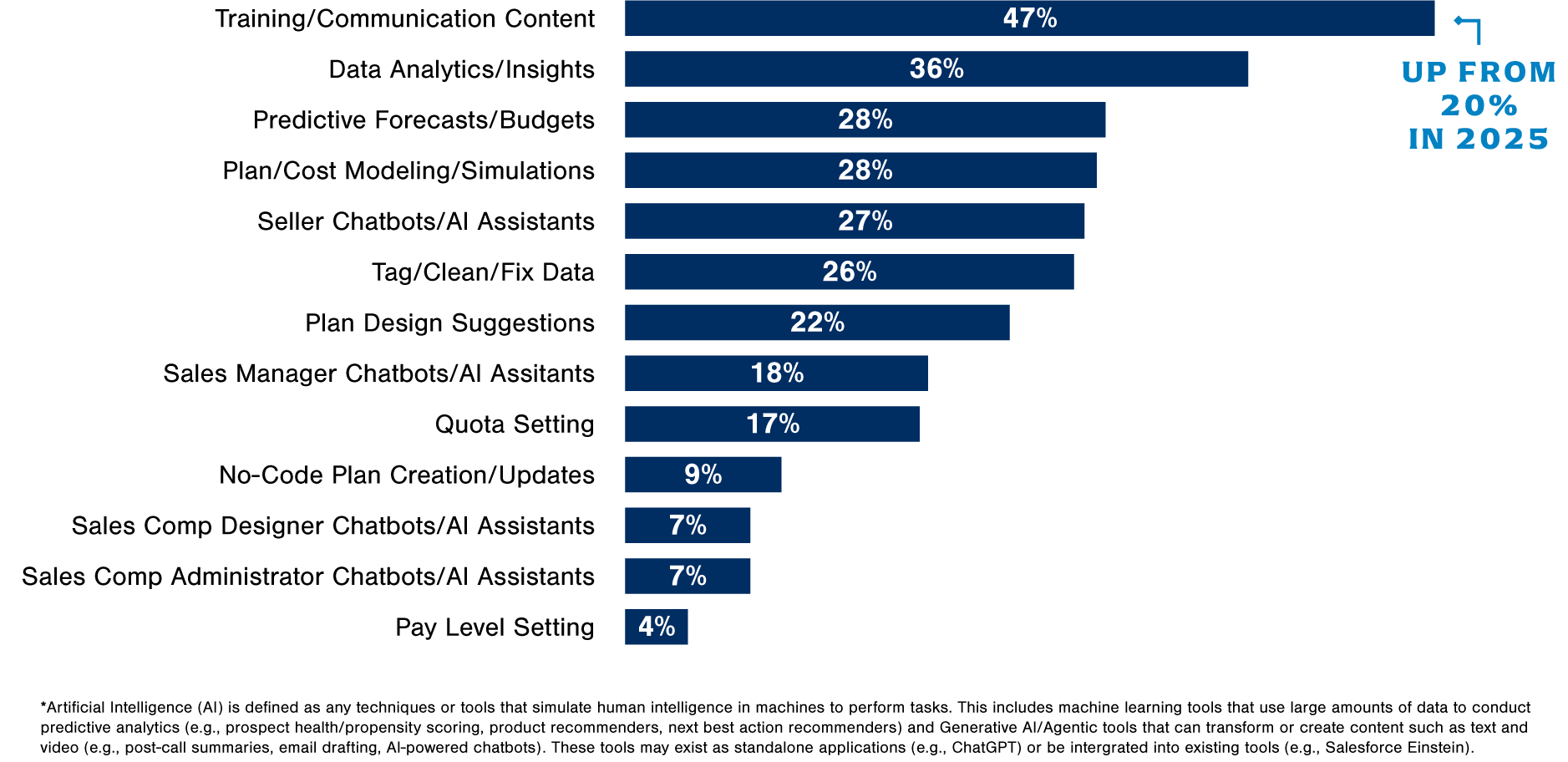
The data reflects how quickly AI is redefining how sellers engage with compensation. Training and communication content has become the leading AI use case in sales compensation in 2026, with adoption rising from 20% to 47% in a single year.29 Additionally, 65% of companies provide little to no clarity around how compensation is determined.30 The gap between plan design intent and seller understanding remains one of the most consistently underestimated drags on compensation effectiveness. Leading implementations address this by providing sellers with a library of high-impact actions drawn from top performers across similar industries, segments, and deal profiles. These insights feed back into how compensation plans are interpreted and operationalized in day-to-day selling, creating tighter alignment between plan intent and actual seller behavior.
Use Case Category 3
Making Design Simulations and Cost Models Intuitive
AI-powered forecasting and scenario modeling give revenue leaders the ability to test decisions before committing to them, with 34% of revenue leaders now using AI for forecasting.31 More accurate forecasts translate directly into better resource allocation, more credible quota setting and fewer mid-year plan adjustments (fourth-most-cited program management challenge across Alexander Group’s research).32
Scenario modeling extends this capability into territory and quota design, enabling compensation leaders to simulate pay-curve changes, accelerator adjustments and territory realignments before deployment with no coding or IT involvement required. More than half of companies cite quota setting as their number one plan design challenge, and 79% believe their plans can be more effective.33 AI-powered simulation gives compensation leaders the evidence to design with confidence rather than adjust after the fact.
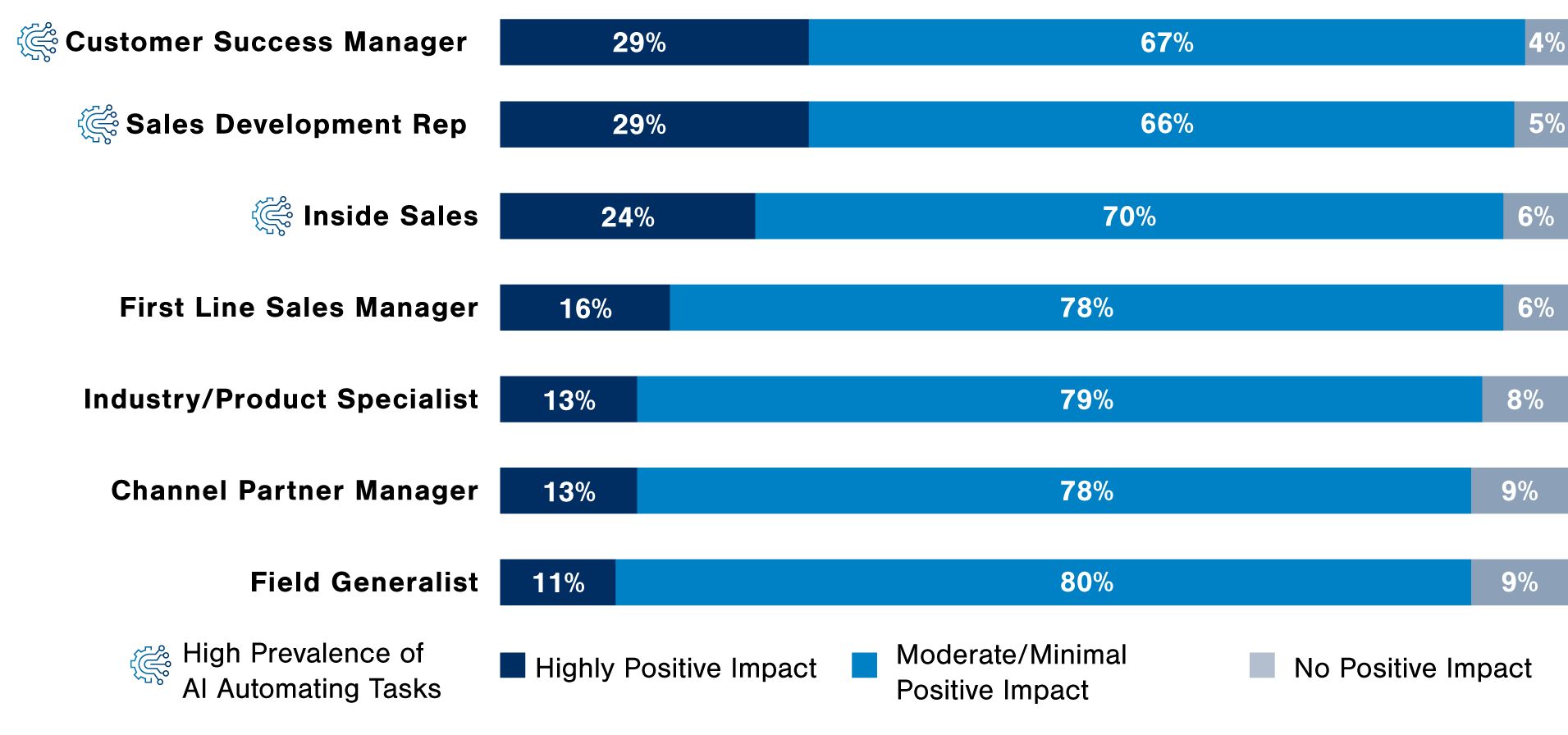
The talent impact reinforces this. Between 91% and 96% of companies expect AI to positively impact GTM roles, with the highest anticipated impact on customer success managers, sales development representatives and inside sales professionals.34 When these roles are freed from manual modeling and administrative forecasting processes, they redirect capacity toward customer engagement, pipeline development and the strategic work that drives higher productivity.
AI Impact on Jobs
Sales Compensation and Talent Management
Sales compensation is one of the most powerful levers available to revenue leaders. It’s also one of the least optimized. As Alexander Group Partner and Global Head of Sales Compensation, Matt Bartels puts it: ‘Sales compensation is more than just a reward mechanism; it is a lever to help overcome business challenges, a spotlight that focuses on what’s important and a catalyst for change and growth.’ With sales compensation, organizations can shape seller behavior, signal strategic priorities and influence talent management. At the same time, it is highly complex. The sales compensation team is responsible for managing many individual plans, crediting scenarios and frequent midyear adjustments.
Rising pressure on performance and efficiency only complicates sales compensation more. Pay increase budgets are returning to normal levels, now running at approximately 3.6% (down from 4.1% two years ago). However, the pressure on the function has not eased. Total sales compensation costs are increasing by approximately 5.3% year-over-year, raising the bar for productivity returns.35 Improving profitability is the primary reason organizations adjust compensation plans, while motivating seller productivity remains the most-cited design challenge. Approximately 65% of companies also report a need to strengthen sales compensation governance and operations, underscoring the function’s operational strain.36 This is supported by Rachel Parrinello, Sales Compensation Solutions Lead at Alexander Group, who notes that “a dedicated sales compensation governance committee is essential for effective oversight and decision-making.”
AI fundamentally reshapes this equation. Across four critical areas—quota setting, plan design and efficiency, seller communication and talent management—AI allows compensation leaders to shift their time away from administrative tasks and toward the strategic work that truly drives commercial performance. That means setting quotas grounded in real market opportunity, designing plans that more precisely align seller behavior with business objectives, giving sellers clear visibility and confidence in their earnings path and personalizing incentives to keep top performers engaged.
A dedicated sales compensation governance committee is essential for effective oversight and decision-making.
Rachel Parrinello, Sales Compensation Solutions Lead at Alexander Group
Quota Setting: Addressing the Number One Challenge
Setting accurate, achievable quotas is the single most cited challenge in sales compensation, and the consequences of getting it wrong are significant. Incorrect quotas can lead to seller frustration, plan gaming, elevated voluntary turnover and compensation cost inefficiency. Traditional approaches, like relying on manager intuition and top-down allocation from a revenue target, lack the precision required to reflect true market potential.
AI offers a more data-driven methodology. Instead of working backward from a revenue target, AI-powered quota models work forward from the market by integrating spend potential, propensity-to-buy estimates, territory opportunity assessments and historical win-rate data to set targets grounded in what is achievable. Companies taking this approach are already seeing a measurable impact. For instance, a major pharmaceutical company that deployed AI analytics to optimize incentives for more than 2,000 field sales representatives achieved a 35% reduction in payout errors, a 25% increase in sales rep satisfaction and a 15% improvement in quarterly sales performance within six months.37 When quotas are grounded in data rather than judgment alone, sellers trust the number and pursue it with greater conviction.
Top Sales Compensation Challenges
Plan Design, Modeling and Efficiency
Compensation plan design has traditionally relied on institutional knowledge, iterative negotiation and limited scenario testing. With AI, leaders can introduce analytical rigor at every stage. Scenario modeling across pay-curve changes, accelerator adjustments and pay-mix shifts can be executed before deployment. All with no coding required and compelling operational benefits.
Manual compensation processes are prone to errors, with 83% of companies failing to pay commissions accurately.38 AI eliminates this risk by building seller trust in the accuracy and fairness of their compensation outcomes and reducing the dispute resolution burden on operations teams.
Beyond efficiency, AI helps decode which elements of a plan genuinely influence seller behavior. By analyzing historical performance and deal patterns, SPM platforms can generate plan recommendations aligned to specific commercial outcomes such as multi-product selling, renewals or multiyear growth. This shifts plan design from art to science. AI-driven quota modeling also provides visibility into where a plan is stretched.
Without that view, organizations don’t have the analytical clarity required to identify structural imbalances in plan design and the associated risks to performance predictability as well as behavioral alignment.
Seller Communication
Training and communication content has become the number one AI use case in sales compensation in 2026.39 The growth reflects two long-standing realities: Sellers who understand their compensation plans perform better, and transparency builds motivation. Still, only 38% of sellers currently understand how their compensation is calculated, leaving the majority without the clarity to connect their activities to their earnings trajectory.40
Complex plan documentation can be converted into interactive video explainers, game-based training modules, personalized earnings calculators and real-time commission dashboards that dramatically improve seller comprehension and engagement. This matters now more than ever, with 66% of companies specifically driving more pay-for-performance in 2026.41 The effectiveness of this strategy depends entirely on whether sellers understand and trust their plans.
Ongoing Plan Support
Train an internal chatbot to handle sales comp plan and administration inquiries:

AI Sales Compensation Use Cases
64% of GTM organizations have enabled AI in at least one use case.
AI and the Talent Agenda
AI is increasingly reshaping how organizations approach talent retention through incentive design. Leading organizations are extending these capabilities to the individual level, using AI to personalize incentive structures.
Research finds that organizations currently using predictive analytics report 38% lower regrettable turnover and 41% better hiring outcomes.42 One financial services firm that deployed machine learning to tailor incentives for over 500 sales agents, matching reward structures to individual performance profiles and career goals, improved agent retention by 18% and increased cross-selling rates by 22% within a year.43 Companies building this level of personalization are establishing a durable talent and productivity advantage. On a larger scale, this is widening the gap between AI-enabled compensation functions and those reliant on manual processes.
RevOps as the AI Orchestration Layer and the GTM Engineer Role
RevOps has always served as the connective tissue across the Sales, Marketing and Customer Success functions. The addition of AI introduces a critical mandate: to govern, deploy and scale AI across commercial organizations.
This is a significant expansion of scope. The three core RevOps activities discussed in Alexander Group’s “Delivering Commercial Excellence” whitepaper—strategy and planning; analytics and reporting; and compensation management—each now have an AI dimension requiring deliberate ownership. Strategy and planning are increasingly informed by AI-driven market models and scenario planning. Analytics and reporting are migrating from static dashboards to real-time intelligence. Compensation management is incorporating AI-assisted quota-setting, cost modeling, plan simulation and communication at scale.
Actions for Commercial Leaders
Commercial leaders seeking to integrate AI into RevOps should adopt a disciplined, structured approach.
- Audit all commercial data sources before deploying any AI model. This includes CRM data, compensation structures, order history, customer data, and any other inputs that will feed your AI models. Even the most advanced algorithms cannot compensate for poor-quality inputs.
- Document workflows and playbooks before automating to ensure effectiveness and alignment with GTM motions.
- Identify two to three high-value AI use cases aligned with the organization's most critical commercial priorities. Deploy them with measurement and scale only after demonstrating impact.
- Leverage AI capabilities that are already embedded within your existing technology stack. Maximize integration before investing in standalone tools.
- Assign a dedicated AI owner within RevOps to oversee deployment, monitor results and drive optimization.
- Implement a structured change management plan that includes clearly defined workflows and playbooks, ensuring transparency with sellers and equipping managers to drive adoption.
GTM Engineer
A new role is gaining significant traction at the intersection of RevOps and AI implementation: the GTM engineer.
Job postings for this title grew from just 63 in early 2024 to 3,342 by the end of 2025, representing a 5,205% increase in under two years.44 This growth is reflected in broader adoption trends, with 54% of the fastest-growing private B2B SaaS companies now having at least one GTM engineer on staff, reflecting how quickly the role has moved from emerging experiment to standard headcount line item.45 The role has emerged in response to declining revenue efficiency, tool sprawl reaching a breaking point with more platforms in the average commercial stack and AI agents requiring dedicated ownership to integrate.
While traditional RevOps professionals design and manage revenue processes, GTM engineers build the infrastructure that makes those processes automated and intelligent. Those in this role connect CRM data, automation tools and AI models into working systems that score leads, route opportunities, trigger actions and measure what is driving revenue—without requiring manual intervention at each step. In practice, this means building and maintaining end-to-end, adaptive workflows that capture and enrich signals, deploy AI models and agents into live environments and continuously refine system responses based on performance data.
The required skill-set reflects this expanded responsibility. GTM engineers increasingly require proficiency in API integration, prompt engineering and data pipeline architecture, with 38% of job postings now explicitly requiring SQL or Python.46 Simultaneously, the average GTM engineer brings four years of commercial experience, combining sales and operations context with deep technical capability and AI fluency.47
The business impact is that organizations deploying AI-augmented GTM engineering workflows have reported customer acquisition cost reductions of 31% in mid-market and 42% in enterprise environments.48 In effect, GTM engineers are becoming the architects of a new revenue layer, transforming disconnected tools into orchestrated systems and turning GTM strategy into scalable, adaptive and measurable execution.
Conclusion
The organizations pulling ahead today are not doing so because they found a better AI tool. They are doing so because they built the infrastructure to make AI work: clean data, defined workflows, clear ownership, connected systems, and the organizational discipline to drive adoption at scale. Top performers concentrate on fewer use cases with deeper execution, building on a connected data foundation where CRM signals and SPM platforms work together as a unified commercial layer rather than in isolation. When that foundation is in place, AI stops being a layer on top of existing processes and becomes the engine underneath them.
Sales compensation is one area where that shift is already generating measurable results. Organizations using AI to set quotas, simulate plan designs and personalize seller communication are seeing improvements in attainment, retention and compensation accuracy that traditional approaches have consistently failed to deliver. Talent management is another area where that shift is generating results, with predictive analytics already reducing turnover and enabling organizations to personalize incentive structures at the individual level.
RevOps is the function best positioned to lead that transition across the entire commercial organization. As the connective tissue between sales, marketing and customer success, it is where data governance, workflow design and commercial strategy converge. Organizations that invest in RevOps as the orchestration layer for AI are building something that individual tools cannot replicate: a scalable, connected system that improves with every planning cycle. The commercial leaders who move with that intention will compound advantages in growth, talent and performance that define the next era of sales excellence. The question for these leaders isn’t whether AI will reshape sales and RevOps. We’ve already seen that it has. The question is whether your organization is building the infrastructure to lead that shift or absorbing the cost of waiting.

AUTHOR

AUTHOR

AUTHOR

AUTHOR

AUTHOR
Aviv Lavi, Consultant
More Resources
Explore All Alexander Group Consulting Services
All Alexander Group Insights
Upcoming Alexander Group Events
1 MIT’s State of AI inBusiness 2025
2 Alexander Group, Sales Pulse Survey, 2025
3 Mindtickle Research
4 PEX Network survey, PEX Report 2025/26
5 Larridin, 2026 State of Enterprise AI Report, January 2026
6 IBM Institute for Business Value, “How AI Is Changing Work,” November 2025.
7 Docebo, AI Readiness Gap Report, 2026.
8 Larridin, State of Enterprise AI 2025
9 MIT Center for Information Systems Research, Enterprise AI Maturity Update, August 2025, survey of 152 enterprises.
10, 11 Lucid, AI Readiness Report, 2026, survey of 2,200 knowledge workers
12 IBM Institute for Business Value; Harvard Business Review, 2024
13 HubSpot, “State of AI in Sales,” 2024.
14 Sopro, AI in Sales and Marketing Statistics, 2025
15 Alexander Group, 2026 Sales Compensation Trends Survey
16 ICONIQ Growth, “Sales Compensation Report,” 2024
17 Gartner, Seller Skills Survey, January–March 2024, 1,026 B2B sellers
18 Alexander Group, Revenue Operations Research, 2024
19 Alexander Group, Revenue Operations Research, 2024
20 Alexander Group, 2026 Sales Compensation Trends Survey
21 Gartner, HR Research, 2024; cited in Treeline Inc., August 2025.
22 Gartner, Sales Forecasting Research, cited in Demand Gen Report, 2025
23 Optifai Benchmark Study, 939 companies, Q1–Q3 2025
24 Alexander Group, AI Use Cases Research, 2025-26
25, 26 Alexander Group, Commercial Data Science Research, 2025
27, 28, 29 Alexander Group, 2026 Sales Compensation Trends Survey
30 Zeren Global, “2025 Compensation Trends: Survey Findings from 250 Industry Responses,” June 2025.
31 Alexander Group, Commercial Data Science Research, 2025
32, 33, 34 Alexander Group, 2026 Sales Compensation Trends Survey
35 Alexander Group, 2026 Sales Compensation Trends Survey
36 Alexander Group, Sales Compensation Research, 2024–2026
37 Alexander Group client case study, pharmaceutical sector (anonymized)
38 Kennect, 2026
39 Alexander Group, 2026 Sales Compensation Trends Survey
40 beqom, “Compensation and Culture Report,” 2025.
41 Alexander Group, 2026 Sales Compensation Trends Survey
42 Emapta, 2026 Employee Retention Statistics
43 Alexander Group client case study, BFSI sector (anonymized)
44 GTME Pulse, State of GTM Engineering Report, 2026, analysis of 3,342 job postings
45 The Signal, GTM Engineering Benchmark Report, 2026.
46 Bloomberry, I Analyzed 1,000 GTM Engineering Jobs — Here Is What I Learned, January 2026.
47 Fullfunnel, State of GTM Engineering Talent, November 2025. Based on analysis of 1,570 new GTM Engineer profiles tracked between September and November 2025.
48 ZoomInfo GTM Intelligence Platform data, 2025.